June 16 – June 23, 2026
-By Deepak Zambre
Deepak Zambre is an innovation-focused technology leader, mentor, and product creator who turns ideas into meaningful, real-world solutions. Through his work and writing, he explores technology, innovation, and purpose-driven ideas that can make everyday life simpler and better.
The Journey to Lahaul & Pangi Valley Begins
Most journeys begin with excitement and end with photographs. We visit beautiful places, listen to stories from guides, admire old temples, monasteries, rivers, valleys and mountains – and for a short while, we feel deeply connected with them.
But slowly, many of those details fade. We remember that a place was beautiful, but often forget why it mattered. We remember standing before an ancient temple, but forget who built it, what style it belonged to, or how it was different from another temple we may have visited earlier. We remember the view, but lose the story behind the view.
During this journey through Lahaul, Pangi and Sural Bhatori, I strongly felt that travel should not remain only a “go, see and come back” experience. It should help us observe, understand, compare, remember and grow.
Every place carries its own geography, history, architecture, faith, folklore, climate, local wisdom and human effort. This travel journal is my attempt to preserve both -the experience of the journey and the understanding behind it. For me, this expedition was not only about reaching destinations. It was about following rivers, crossing mountain roads, visiting old temples and monasteries, sharing laughter with fellow travellers, asking questions, and returning home with a deeper desire to understand the places we visit.
Day 1: From Pune to the Older Soul of Manali on Lahaul & Pangi Valley Journey
Before Sunrise: The Journey to Lahaul & Pangi Valley Begins
True travel often begins long before you set foot on the path – in the quiet hours before sunrise, when bags are packed and excitement slowly takes over. For us, the journey began at Pune Airport around 4:00 AM, as my family and fellow travellers met our tour leader, Mr. Bhushan Sathe. Our flight reached Chandigarh in about two hours, where we met our local guide, Mr. Ashok. His warmth made him feel less like a guide and more like someone from our own group.
The 310 km Road Journey to Manali
From Chandigarh, our 310 km road journey toward Manali began. Mountain kilometres are never only about distance – they are about bends, climbs, pauses, rivers, changing weather, and the gradual feeling that the plains are falling behind. As we moved northward, wider roads gave way to hill roads, with cooler air, pine-covered hillsides and distant ridgelines.
Following the Beas River
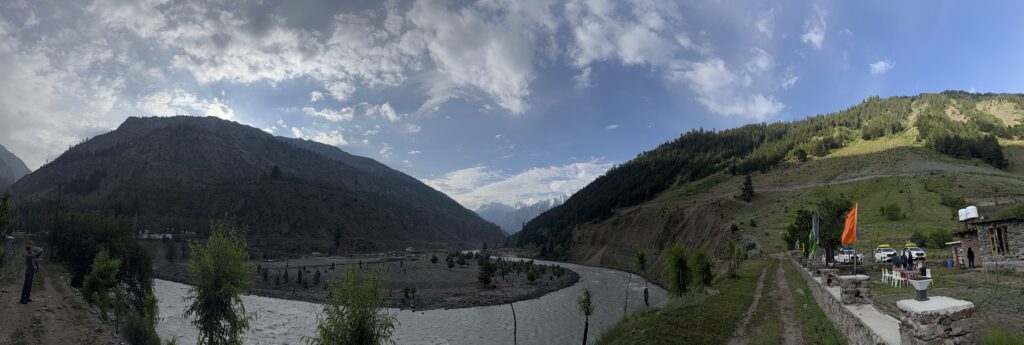
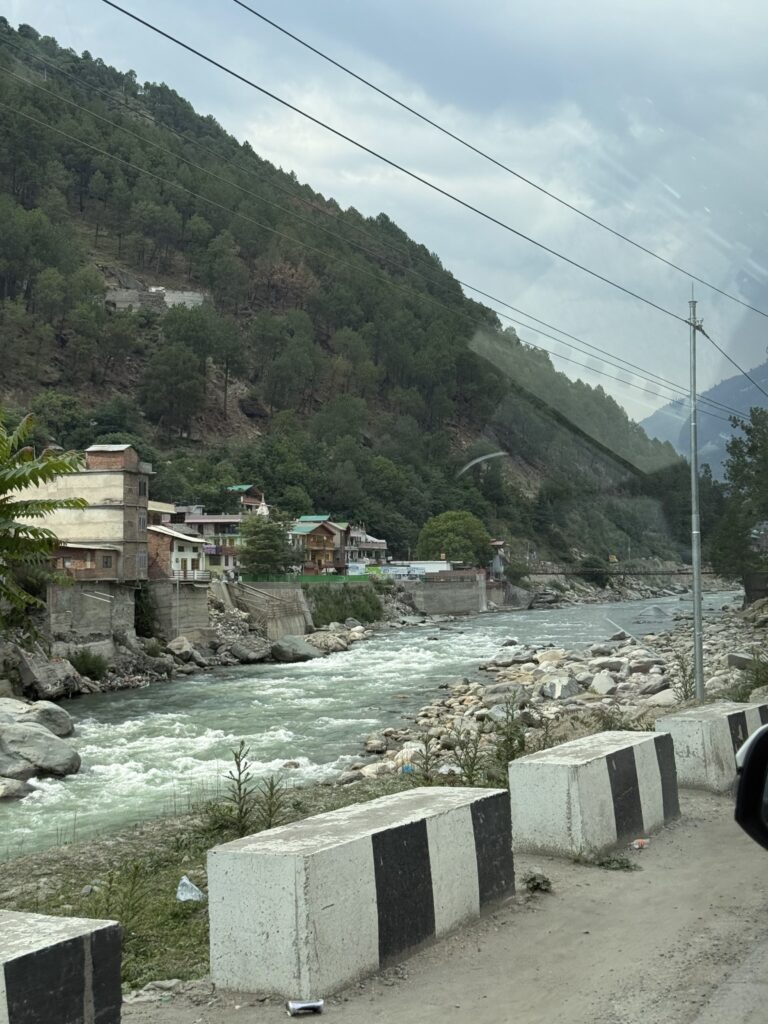
Somewhere along the route, the Beas River joined us, making it feel less like we were simply driving toward Manali and more like the river was guiding us into the mountains. At places it flowed quietly like green glass; elsewhere, it rushed over rocks, white with foam. The views gradually became more interesting than our phones.
The First Breakfast Together
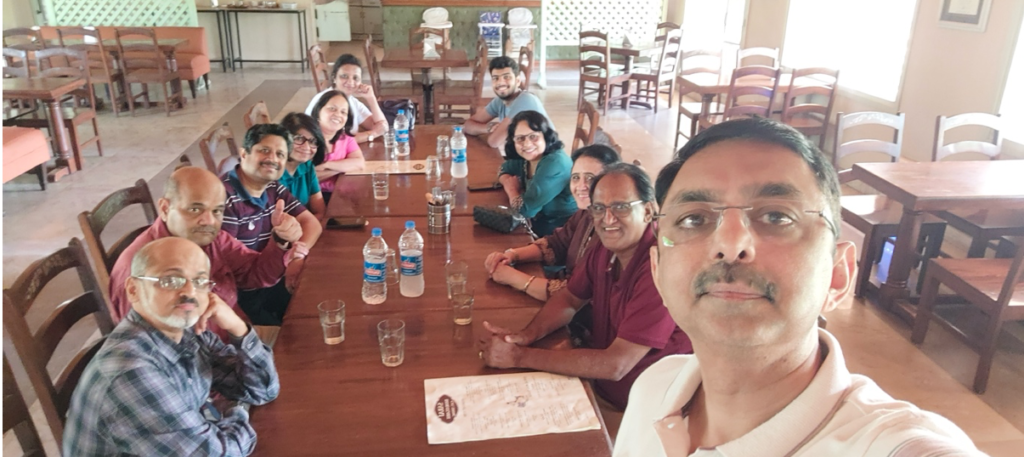
We had our first breakfast together on the way – a small but important moment as the group began settling into a rhythm. Shared travel quietly removes formality, and soon we exchanged plates, made jokes, and started discussing the route.
The Himalayas Begin to Reveal Themselves
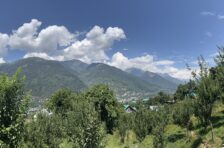
This drive reminded us how gradually the Himalayas reveal themselves. Around Manali, the mountains felt familiar, yet the Kullu Valley had its own charm. Villages appeared on hillsides, roads curved around the mountains, and trees rose from steep slopes. The journey was already preparing us to slow down and notice more.
Reaching Manali
By evening, after nearly eight hours on the road, we reached Manali. At around 2,050 meters, Manali sits in the Kullu Valley, framed by the Pir Panjal range and shaped by the Beas River. For many travellers, Manali is the destination; for us, it was different.
It was not the end point of the journey. It was the doorway.
Manali: The Doorway to the Lahaul & Pangi Valley Expedition
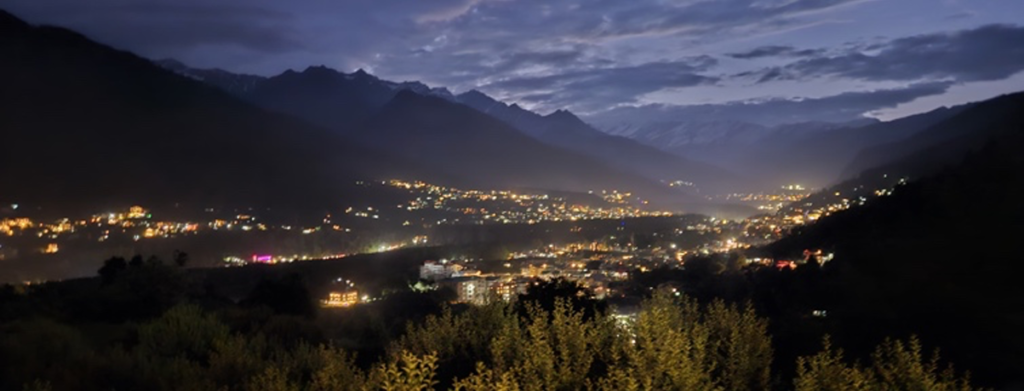
The real expedition was still waiting beyond the familiar mountain town, somewhere deeper in the Himalayas. As darkness settled, Manali began to glow beneath us, its lights shimmering across the valley while the peaks disappeared into the night.
The air was cooler, the body tired, but the mind wide awake. Looking down at those lights, I felt we had crossed our first invisible milestone. We had reached the mountains, but only the outer door had opened.
Tomorrow would be our first day on foot – through Shuru and Jagatsukh, deodar forests, old temples and local traditions. This journey was not going to be only about reaching places.
It was going to be about noticing them.
Day 2: Acclimatization- Walking into the Older Soul of Manali during Lahaul & Pangi Valley Journey
Shuru → Maa Sharvari Temple → Jagatsukh Village → Manali
Approx. 5 km walk | Lower Pir Panjal slopes | Night halt: FogHills Cottages, Manali
A Mountain Morning
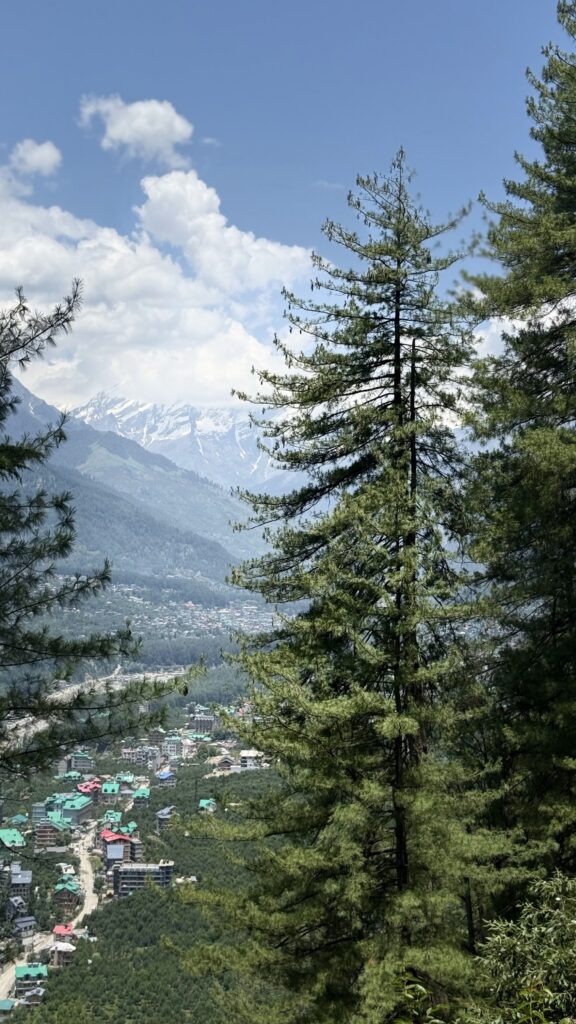
The next morning began with the freshness of the mountains. The Manali we had seen as scattered lights the previous night now stood open before us – rooftops, trees, slopes and ridgelines. After breakfast, we set out from Shuru toward Jagatsukh on a gentle acclimatization walk that soon became much more.
Seeing Manali on Foot
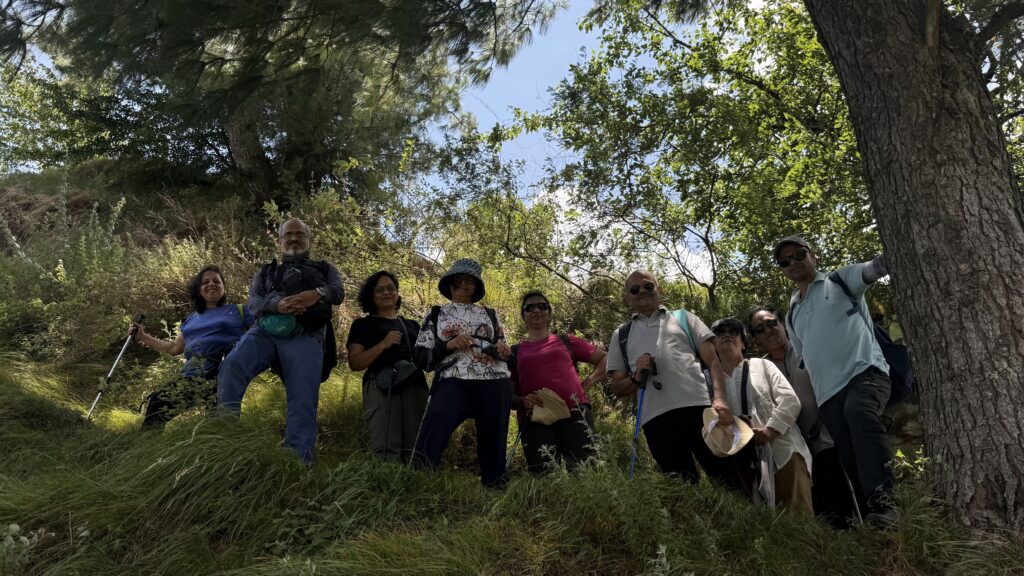
A place reveals itself differently when one walks through it. From a vehicle, mountains look grand; on foot, they become intimate. The trail took us through deodar forests, orchards, village paths and mountain settlements, with apple and plum trees along the way.
Some low-hanging fruit was close enough to pluck and taste – crisp, fresh and sweeter than anything we usually buy in city markets. That simple taste became one of those small memories that no photograph can fully capture.
Maa Sharvari Temple, Shuru
Our first important halt was Maa Sharvari Temple, hidden inside the quiet forest near Shuru. Its beauty was not in grand scale, but in its setting – the surrounding forest, wooden structure, and the feeling that the shrine belonged naturally to the landscape.
Heritage Profile: Maa Sharvari Temple, Shuru
Altitude: Approx. 2,100 m / 6,890 ft
Setting: Forested slopes near Shuru, above Manali
Mountain Context: Lower Pir Panjal range, Kullu Valley
Tradition: Associated with Goddess Sharvari, revered as the Kuldevi of the Kullu royal lineage
Architecture: Kath-Kuni Himalayan wood-and-stone style, using interlocked layers of timber and stone
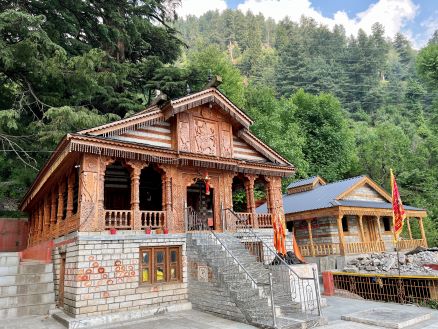
What makes Maa Sharvari Temple special is the way it shows how Himalayan architecture grew from its surroundings. In the mountains, builders had to think about snow, earthquakes, timber, slope, and isolation.
The result is not showy grandeur, but quiet strength. This was one of the first places where I felt that architecture cannot be separated from geography.
A temple in the Himalayas is not only built for worship. It is also built to survive the mountain.
A Festival Procession in the Forest
Midway through our walk, the silence of the forest was broken by music and movement. We came across a local festival procession from Takshak Naag Temple at Bhanara village, with villagers carrying a decorated palakhi down the steep muddy slopes with a speed and confidence that amazed us.
We, on the other hand, had to place every step carefully just to keep our balance. That contrast stayed with me.
For us, it was a trek. For them, it was home.
A 700-Year-Old Mountain Home
Along the route, we saw a house believed to be around 700 years old, built using thick deodar wooden logs and blocks. It did not look like a monument, but carried the dignity of something that had survived time, weather and generations.
Standing before it, I felt that heritage is not always found in temples and forts. Sometimes it lives in old homes, construction techniques, the choice of wood, and the wisdom of those who knew how to build with the mountain rather than against it.
Jagatsukh: A Village with an Older Identity
By the time we reached Jagatsukh, we were stepping into a village with a much older identity. Once the capital of the medieval Kullu kingdom, Jagatsukh still carries its history quietly, without trying to impress. Here we visited the Gayatri Temple and the nearby Lord Mahadev Temple.
Heritage Profile: Gayatri Temple, Jagatsukh
Altitude: Approx. 2,050 m / 6,726 ft
Setting: Jagatsukh village, Kullu Valley
Historical Period: Originally associated with the 8th century; later rebuilt or renovated around the early 15th century
Patronage: Linked with Maharaja Udharan Pal of Kullu
Architecture: Western Himalayan stone Shikhara style, with a timber verandah suited to the mountain climate
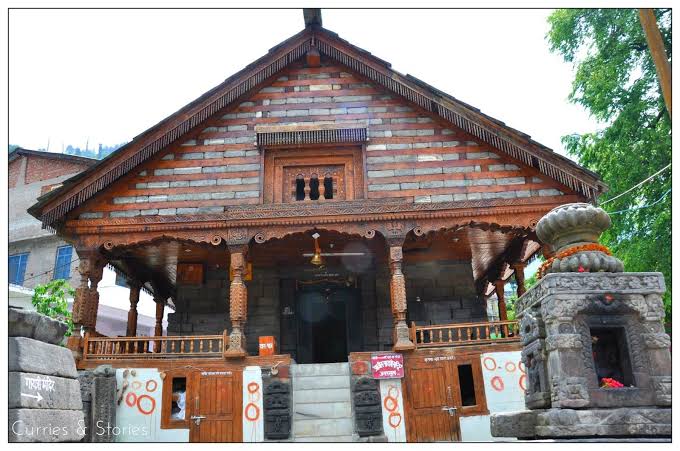
The Gayatri Temple shows how Himalayan temples carry many layers of time. Its stones, verandahs, roofs and sanctum preserve centuries of faith and rebuilding, while the use of local stone and timber reflects the adaptation of temple architecture to the mountain climate.
What interested me most was the combination of classical temple form and local mountain practicality. It made me curious to observe how the same broad Indian temple traditions changed their appearance across different geographies.
A Taste of Himachali Tradition: Siddu
At Jagatsukh, we tasted Siddu, the local steamed Himachali bread stuffed with poppy seeds and spices. It was one of the food highlights of the day, and even now I feel I should have made a full meal out of it instead of saving my appetite for the more routine food later in Manali market.
That is the charm of local food. Sometimes one small thing eaten on a village step becomes more memorable than an entire planned dinner.
Evening in Manali
We spent the evening around Manali market before returning to FogHills Cottages. Our group also grew that day, as Dr. Preethi joined us and became part of the journey from here onward.
The Journey to Lahaul & Pangi Valley Begins to Go Deeper
By the end of Day 2, the tour had already shifted from sightseeing to something deeper.
We had walked through forests, tasted fruit from trees, watched a local procession, visited old temples, and begun to understand that every place has more layers than it first reveals.
But this was only the beginning.
Tomorrow, the journey would take us beyond the familiar side of Manali and into a very different Himalayan world – deeper valleys, high mountain roads, remote villages, living heritage and landscapes that few travellers get to experience.
There is much more to this journey – and the road ahead has only just begun.
The story continues in Part 2 and Part 3, as we travel deeper into the heart of Lahaul, Pangi and Sural Bhatori.